
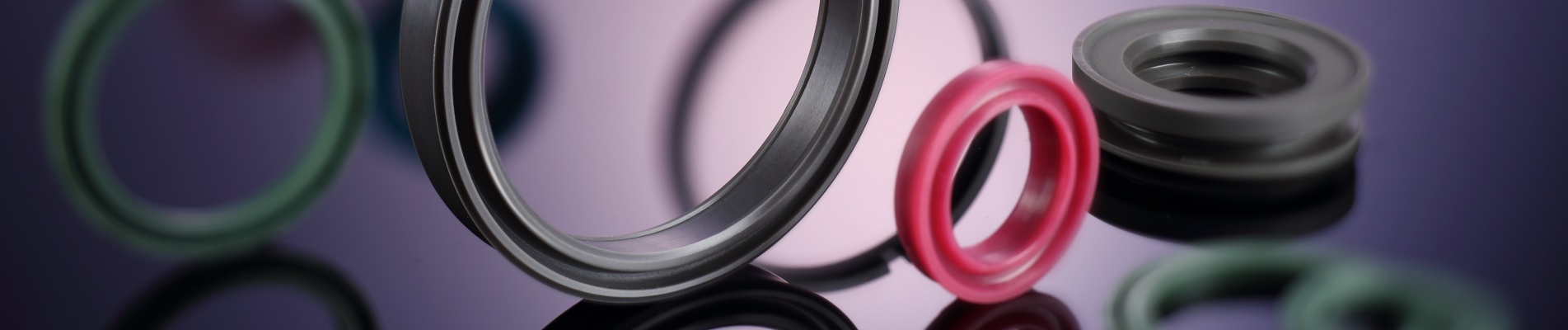
How to choose the right hydraulic seal for a cylinder? Focus on six key factors: seal location, operating pressure, temperature, hydraulic fluid, movement speed, and installation dimensions.
Hydraulic seal selection should not be based on size alone. The appropriate seal design and material should be selected according to the cylinder's actual operating conditions. The right seal helps prevent hydraulic leakage, reduce friction and wear, and maintain reliable cylinder performance.
What Types of Hydraulic Seals Are Used in a Cylinder?
A hydraulic cylinder does not use just one type of seal. Depending on their location and function, multiple sealing elements typically work together as part of a complete hydraulic cylinder sealing system.
Rod seals are installed between the cylinder head and the piston rod. Their primary function is to prevent hydraulic fluid from leaking to the outside along the clearance between the piston rod and cylinder head.
Because the piston rod continuously moves back and forth during operation, rod seals must provide reliable sealing performance as well as good wear resistance, friction characteristics, and extrusion resistance. Therefore, the seal design and material should be selected according to the actual operating pressure, speed, and fluid.
Voneseals provides a range of hydraulic rod seals. Suitable seal designs and materials can be selected according to pressure, speed, temperature, fluid, and installation dimensions.
Piston seals are installed on the piston of a hydraulic cylinder to prevent internal leakage between the two sides of the piston. In double-acting hydraulic cylinders, piston seals typically need to withstand pressure from both directions, so the appropriate seal design should be selected according to the cylinder's operating pressure, movement speed, and construction.
Piston seals are commonly used in hydraulic cylinders, construction equipment, industrial hydraulic systems, and other reciprocating applications. For high-pressure or heavy-duty conditions, particular attention should be paid to extrusion resistance and wear resistance.
Voneseals provides a range of hydraulic piston sealing solutions, including:
Wiper seals are installed at the outer side of a hydraulic cylinder. Their primary function is not to prevent hydraulic fluid leakage, but to keep dust, water, dirt, and other contaminants from entering the cylinder.
For hydraulic equipment such as excavators, loaders, and mining machinery that frequently operates outdoors or in harsh environments, the piston rod is exposed to dust, mud, and other contaminants. Wiper seals therefore play an important role in protecting the internal sealing system and hydraulic system.
Voneseals provides wiper sealing products for different hydraulic cylinder designs and working environments, including:
During hydraulic cylinder operation, guide rings help support radial loads and reduce direct contact between the piston, piston rod, and cylinder bore, thereby reducing wear and improving operating stability. They are particularly suitable for hydraulic cylinders and heavy-duty equipment subject to significant lateral loads.
Under high-pressure conditions, seals may be subjected to significant extrusion forces. If the sealing clearance is large, sealing elements such as O-rings may be forced into the clearance, resulting in extrusion damage.
Backup rings can help reduce this risk and improve the extrusion resistance of the sealing system under high pressure.
Therefore, when selecting hydraulic seals, the need for a backup ring should be evaluated together with the pressure, clearance, and overall design of the sealing system.
What Factors Should Be Considered When Selecting Hydraulic Seals?
After determining the seal type, further selection should be based on the actual operating conditions of the hydraulic cylinder.
Different installation locations serve different functions, so one type of seal cannot solve every sealing requirement.
| Installation location | Common Types of Seals | Primary function |
| Rod position | Rod Seal | Prevent external hydraulic fluid leakage |
| Piston position | Piston Seal | Prevent internal leakage |
| Outer side of cylinder head | Wiper Seal | Prevent contaminants from entering |
| Piston / rod guide position | Guide Ring | Guide and support lateral loads |
| O-ring interface | Backup Ring | Improve extrusion resistance |
Therefore, before selecting a seal, first identify where it will be installed and what sealing problem it needs to solve.
Operating pressure is one of the key factors in hydraulic seal selection.
The higher the pressure, the greater the load on the seal, and the greater the requirements for material strength, seal design, and extrusion resistance are generally likely to be.
If the hydraulic cylinder experiences significant pressure spikes or a large extrusion gap, particular attention should be paid to the seal's extrusion resistance. Depending on the application, backup rings, guide rings, or other auxiliary sealing components may also need to be considered.
Temperature affects the hardness, elasticity, wear resistance, and long-term stability of sealing materials.
Therefore, do not consider only the cylinder's normal operating temperature. Also consider:
For example, some materials may perform well at room temperature but experience performance degradation under continuous high-temperature conditions.
The sealing material must be compatible with the hydraulic fluid used in the application.
Common hydraulic systems may use different types of hydraulic fluids, including:
If the material is incompatible with the fluid, it may swell, shrink, harden, soften, or otherwise change its properties, potentially resulting in leakage or seal failure.
Therefore, when selecting a sealing material, provide the hydraulic fluid type together with the operating temperature and operating pressure.
How to Choose the Right Hydraulic Seal Material?
Material is another key factor in hydraulic seal selection.
Different materials offer different levels of wear resistance, temperature resistance, chemical resistance, friction performance, and mechanical strength.
Common materials include:
| Material | Key Characteristics | Typical Applications / Considerations |
| PU (Polyurethane) | Good wear resistance and mechanical strength | Dynamic hydraulic sealing and heavy-duty applications |
| PTFE (Polytetrafluoroethylene) | Low friction and chemical resistance | Applications requiring low friction and chemical resistance |
| NBR (Nitrile Rubber) | Good oil resistance and balanced overall performance | General hydraulic applications |
| HNBR (Hydrogenated Nitrile Rubber) | Improved heat and aging resistance compared with NBR | More demanding hydraulic environments |
| FKM (Fluoroelastomer) | Good high-temperature and chemical resistance | High-temperature or special-fluid applications |
It is important to note that there is no single “best” sealing material for every hydraulic cylinder. Material selection should be based on the specific operating conditions rather than simply prioritizing one material's individual performance. You can refer to Voneseals material information to understand the characteristics and typical applications of different materials as a starting point for selection.
Consider the Interaction Between Seals (System-Level Selection)
Seals should not be selected in isolation. A hydraulic cylinder is an integrated sealing system in which the individual sealing components work together in sequence to maintain sealing performance and stable operation.
If one component is incompatible with the others, it may affect the reliability of the entire sealing solution. Therefore, seal selection should evaluate the compatibility and interaction of the sealing components as a system rather than selecting each component separately.
Key interactions between sealing components:
Therefore, seal selection should consider the interaction between sealing components, material compatibility, and the overall system design to ensure that all components work together effectively.

Common Mistakes When Selecting Hydraulic Seals
Size compatibility is fundamental, but it is not the only consideration. Seals with the same dimensions may perform differently if their materials, designs, or pressure ratings are different.
If the seal does not have sufficient extrusion resistance, it may suffer extrusion damage under high pressure or with a large clearance.
A material may have good temperature resistance but may not be compatible with every hydraulic fluid.
Construction equipment, mining equipment, and industrial hydraulic equipment operate under different conditions. Seals should be selected according to the actual application rather than simply copying a sealing solution used on another piece of equipment.
If the piston rod, cylinder bore, or seal groove has significant damage, replacing the seal alone may not fully resolve the leakage problem.
Hydraulic Seal Selection Checklist
Before requesting a quotation from a seal supplier, prepare the following information:
☐ Rod diameter
☐ Cylinder bore diameter
☐ Seal groove dimensions
☐ Seal installation location
☐ Operating pressure
☐ Operating temperature range
☐ Hydraulic fluid
☐ Piston rod speed
☐ Stroke and operating frequency
☐ Working environment
☐ Existing seal part number, dimensions, or sample
☐ Special material, non-standard dimensions, or OEM requirements
Providing this information helps determine the appropriate seal type, material, and specifications more accurately.
Not Sure Which Hydraulic Seal to Choose?
If you are unsure which seal type or material your hydraulic cylinder requires, provide Voneseals with the cylinder dimensions, photos or part number of the existing seal, operating pressure, temperature, hydraulic fluid, and application details. We provide material options including PU, PTFE, NBR, HNBR, and FKM for different application requirements.
For non-standard dimensions or special applications, based on the cylinder dimensions, existing seal, operating pressure, operating temperature, hydraulic fluid, and application details provided by the customer, Voneseals can help evaluate the appropriate seal type, material, and design, and provide customized and OEM sealing solutions.
Leave A Message
Scan to wechat :